IP Resolution and Intent Signal Pipelines for B2B Visitor Identification
IP resolution alone no longer identifies B2B visitors reliably.

Reverse-IP lookup became the backbone of B2B visitor identification because the logic behind it held up for a long time. Employees browsed the web from office buildings, those offices sat behind IP ranges their companies owned or leased, and those ranges were registered with ARIN, RIPE, or APNIC. A WHOIS lookup against those registries returned a company name with reasonable confidence, and that confidence became the foundation of an entire product category.
A JavaScript snippet on a website captures a visitor's IP address, a tool runs that IP against a database of mapped corporate ranges, and a match returns a company name, industry, size, and location, along with whatever pages that visitor viewed. None of this required guesswork or modeling. It required a clean map between an IP block and an employer, and for most of the 2010s, that map was accurate enough to build real products on.
What made reverse-IP viable at scale wasn't the lookup mechanism itself. The assumption sitting underneath it was that daytime B2B traffic came from office networks, and that office networks pointed back to identifiable companies. For a decade, that assumption held well enough that sales and marketing teams built entire account-based marketing programs on top of it.
That assumption is the piece now under strain. Over 60% of knowledge workers browse from home networks that resolve to residential ISPs rather than company names, which means the map a reverse-IP lookup depends on no longer matches where the traffic actually originates.
Four structural forces that are eroding reverse-IP accuracy in 2026
Reverse-IP accuracy is dropping because the traffic those databases get asked to resolve has shifted in ways that turn a once-reliable signal into noise. Four separate structural trends are driving that shift, and none of them depend on a single vendor's technology falling behind.
Remote and hybrid work scattered the corporate IP footprint that reverse-IP depends on. The same employee might be identifiable on a day spent in the office and invisible the next day while working from a home network.
Consumer privacy tooling has moved from niche to default. Apple's iCloud Private Relay hides a visitor's originating IP behind Apple-operated relays, built specifically to block IP-based geolocation and identification. VPNs do similar damage: they route a corporate laptop's traffic through a residential or datacenter exit node, often in a different city or country, cutting the link between IP and employer.
A growing share of web requests now comes from datacenter IP space. Reverse-IP lookup against that traffic either returns the cloud provider's name, which is useless as an account signal, or a stale tenant mapping that returns a confidently wrong company.
IP-to-company mappings also decay on their own, without any new technology causing it. A reverse-IP database is a snapshot of a map that starts going out of date the moment it's published, and a mapping that was accurate a year ago may now point at a company that no longer holds that IP range, with nothing in the system flagging that the match has expired.
Coverage, how often any company name gets returned, and accuracy, how often that name is correct, are two different measurements, and a headline figure built on the first can look impressive while saying little about the second.
How AI agents specifically accelerate the degradation and introduce a new category of pipeline error
AI agent traffic is a different kind of problem from the four forces above, and it's moving faster than any of them. These agents don't just fail to resolve correctly under reverse-IP lookup. They actively corrupt the intent data that downstream account-based marketing and lead-scoring programs depend on.
Agentic browsers and AI buying assistants fetch web pages from datacenter IPs with no human session behind them, no cookies, and no consistent device fingerprint to anchor an identity. Reverse-IP lookup against that traffic returns either the cloud provider's name or a stale tenant mapping, never the buyer's actual employer. When that error flows downstream, ABM and intent-scoring programs inherit it directly: false company matches, inflated account lists, and intent scores built on activity no human ever generated.
Detection isn't uniform across the different kinds of agents making these requests, and a working taxonomy has emerged to separate them. The harder category is undeclared and masquerading traffic. Behavioral reports describe xAI's Grok crawler rotating through datacenter and proxy IPs while spoofing Safari or Chrome user agents, which makes it functionally indistinguishable from a human visitor to any detection system that relies on IP data alone.
That last category is the reason self-declaration can't be the whole strategy. Effective bot detection in 2026 combines four separate signal families: identity signals pulled from HTTP headers and TLS fingerprints, network signals such as ASN and IP reputation, browser signals drawn from JavaScript-observable device properties, and behavioral signals built from mouse movement, keystroke patterns, and navigation flow. No single one of these signals is sufficient on its own, which is what a crawler like Grok's is built to exploit.
Platform infrastructure is starting to catch up to this problem. Cloudflare's official blog post describes a July 1, 2026 launch giving website owners finer control over bot traffic: "Instead of a one-size-fits-all block, all customers can now easily distinguish and manage Search, Agent, and Training bots, alongside the new ability to protect ad-monetized pages." Maverick Intelligence detects and reports on AI agents, including ChatGPT, Claude, and millions of other agents, surfacing which content they consume and which operators run them. That gives B2B teams a view into both the human buyers on their site and the AI systems increasingly doing research on those buyers' behalf.
What the full signal pipeline looks like when IP resolution is treated as one layer rather than the whole solution
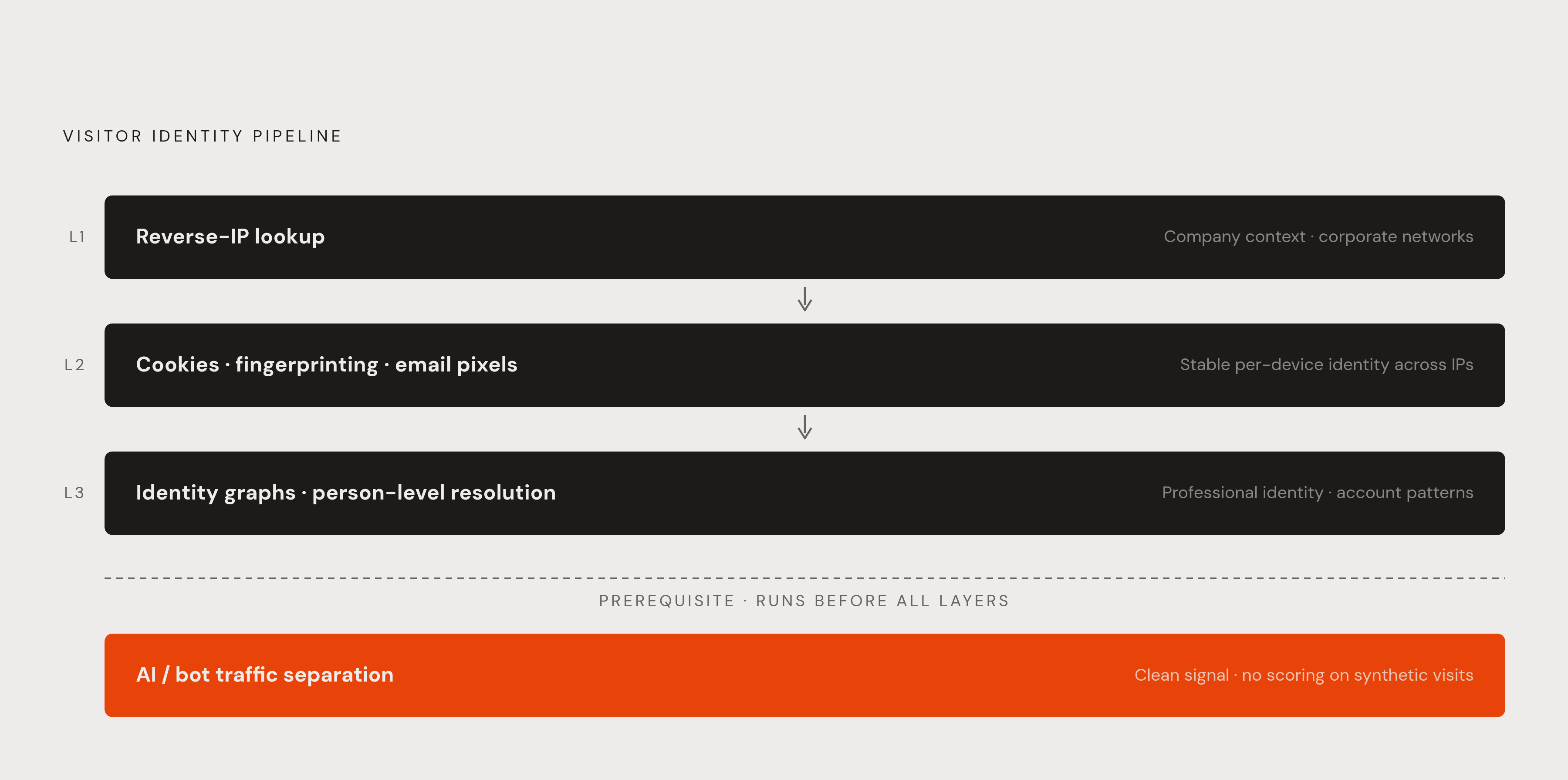
Additional layers must compensate for the structural ceiling IP resolution runs into on its own. Treated as a foundation rather than a complete answer, reverse-IP lookup still has a real role to play inside a larger pipeline built to cover its blind spots.
Layer 1, reverse-IP lookup itself, is a foundation for the pipeline. For traffic still coming from on-premise corporate networks, this layer continues to perform well. Its output is account context, not a person record, and pipeline errors tend to start exactly where that distinction gets ignored.
Layer 2 adds first-party cookies and device fingerprinting on top of that foundation. Device fingerprinting works differently, pulling browser attributes like screen resolution, timezone, installed fonts, and WebGL renderer into a semi-unique identifier that tends to stay stable per device even as the underlying IP address changes. Email pixel matching adds a third input here: when a prospect clicks through from a marketing email, it creates a deterministic link between a known email address and an on-site session.
Layer 3 moves to identity graphs and person-level resolution. The identity graph checks three things: whether a device or cookie matches a known professional identity, whether a given IP has shown up with previous known visitors before, and whether the behavioral pattern on this session matches a known account. Match rates here depend heavily on the size and accuracy of the underlying graph. Waterfall enrichment across multiple data sources tends to outperform any single source on its own.
Agent traffic has to be separated from human traffic before any of this scoring or enrichment logic runs, a prerequisite rather than an additional layer beneath all three of those layers. Skipping that step means running an identity pipeline against inputs that will never resolve to an actual buyer, no matter how good the layers above it are.
Where each layer degrades in practice
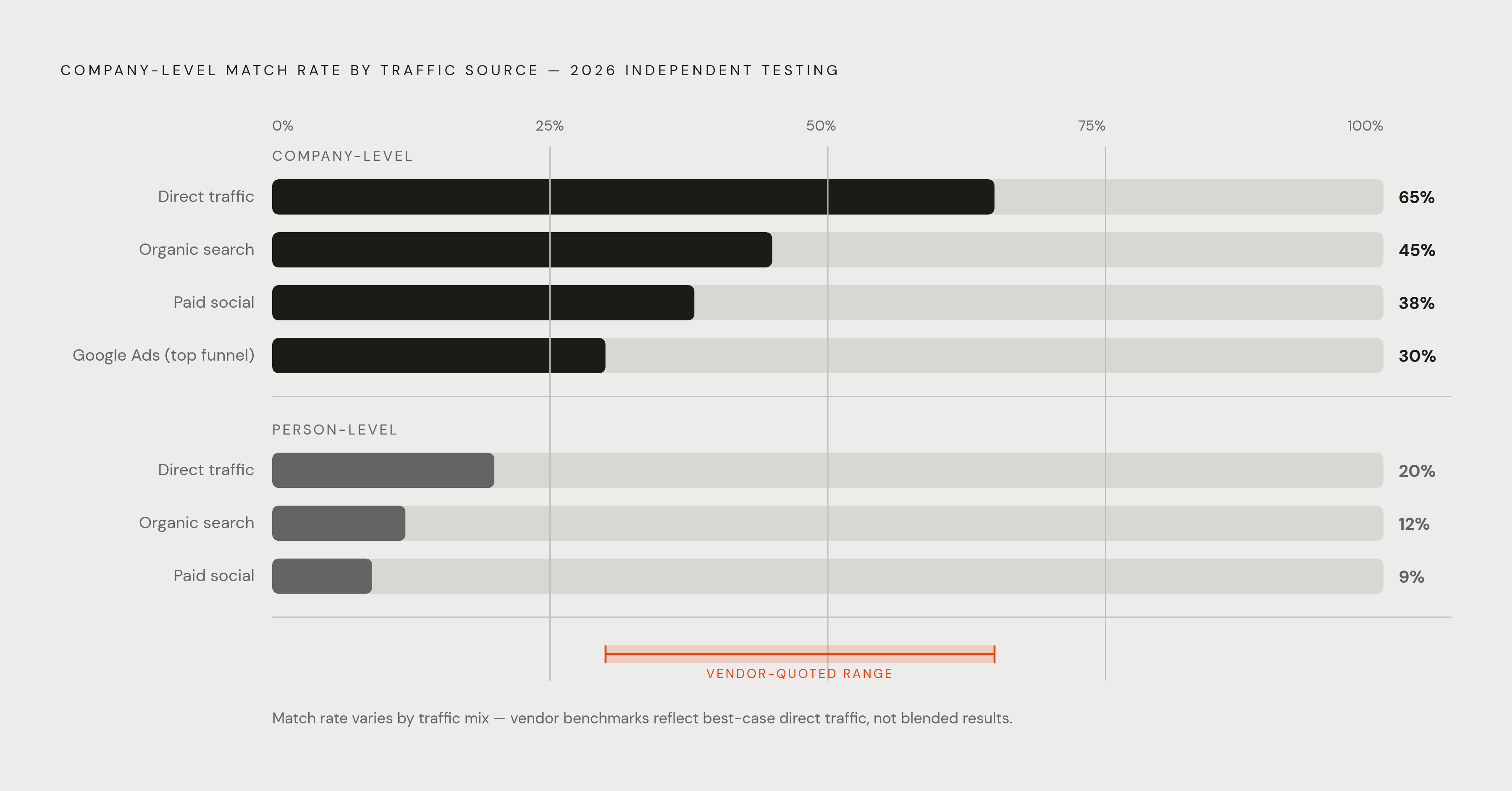
Every layer in that pipeline has a structural ceiling, and naming those ceilings honestly is what separates a reliable identification program from one built on vendor-quoted numbers that don't survive contact with real traffic.
The IP resolution layer tops out well below what most vendors advertise. Independent testing in 2026 puts realistic company-level match rates at 30% to 65% of US B2B traffic, a wide enough range that the honest answer to "what will this tool identify" depends heavily on the traffic mix being tested. Match rates also shift by traffic source: direct traffic identifies best at the company level, organic search and paid social trail behind it, and Google Ads traffic, particularly on top-of-funnel keywords, tends to identify at the lowest rates of all.
Person-level resolution carries its own, smaller ceiling. It returns names, titles, and contact details, but it matches a meaningfully smaller share of traffic than company-level identification does. Person-level tracking also raises real GDPR and CCPA questions that company-level identification mostly avoids: firm-level identification is generally permissible under legitimate interest, while person-level tracking requires explicit consent mechanisms that many sites haven't built.
The trade-off that should drive every evaluation here is accuracy against coverage, and accuracy itself splits into two separate measurements. Match rate describes the share of sessions that resolve to a known entity. Match quality describes how correct and usable that resulting record actually is. A tool can post a high match rate by returning low-confidence guesses on nearly every session, or it can post a lower match rate by returning only verified records it can stand behind. Teams evaluating a tool should test it against their own real traffic, including remote workers, VPN users, and mobile sessions, rather than taking a vendor's benchmark run against a curated test set at face value.
How identified visitor data connects to paid media attribution
The cost of a degraded identification pipeline goes beyond missed sales outreach. It extends into paid media budget, which gets evaluated on incomplete evidence and optimized toward the wrong signals.
When the pipeline works as intended, it closes a specific gap in how paid campaigns get judged. A team running a LinkedIn campaign can see that it brought a set of named, ICP-fit accounts to a pricing page, even if only a fraction of those visitors ever filled out a form, and evaluate the campaign against that evidence alongside the form-fill count.
Identified visitor data supports paid media in two distinct ways. Suppression removes identified visitors from paid retargeting audiences, directing that budget at visitors who couldn't be identified, the segment where paid retargeting remains the only signal available. Match rates on business email lists differ materially between LinkedIn and platforms like Google or Meta, which makes LinkedIn suppression a particularly high-value use case for B2B teams specifically. Audience seeding is the second use: feeding a rich audience of identified, high-intent visitors with real firmographic attributes into lookalike modeling produces better lookalikes than feeding a thin, pixel-based visitor audience, because the algorithm learns from the composition of the seed audience, not just its raw size.
Closing the loop requires linking visitor identification data directly back to the ad platform. Maverick's integrations with HubSpot, Salesforce, Slack, Attio, and major ad platforms including Google Ads, Meta, and TikTok let teams attribute paid media spend to the actual companies and individuals it influenced, connecting the identification layer to the campaign layer without a manual export step in between.
How CRM and workflow integrations determine whether identification data reaches the people who act on it
Identification data that lands in a separate dashboard, rather than inside the CRM or communication tool a sales rep already has open, rarely generates action. The friction of switching tools is enough on its own to erase most of the value the pipeline built upstream.
The standard integration layer for B2B visitor identification tools includes native connectors to HubSpot, Salesforce, Pipedrive, and Slack, with Zapier typically serving as a third-party bridge. It's whether that integration runs both directions. HubSpot's own native visitor identification illustrates the gap well: it recognizes returning contacts already in its database but doesn't resolve net-new anonymous visitors to person records the way a dedicated identification platform does. Its Website Visits tool can resolve anonymous traffic to company-level records through IP matching, but if teams rely solely on HubSpot's built-in capability, they still face a structural gap on net-new account identification.
Getting CRM routing to work at full signal fidelity takes some deliberate setup. Practitioners build custom contact and company properties for each distinct signal type, an intent topic surge, a G2 comparison page visit, a funding event, using dropdown or date fields so the data stays filterable and sortable. When a signal fires, automation creates a deal in a dedicated pipeline with the signal type, source, and timestamp attached to it.
Timing determines a large part of that value. A visitor who hit a pricing page an hour ago represents a different outreach opportunity than one who hit it three days ago, and Slack alerts combined with real-time CRM writes let identification data keep that timing value. Maverick's integrations with Slack, HubSpot, Salesforce, Attio, Gmail, Outlook, LinkedIn, n8n, and ad platforms including Google Ads, Meta, and TikTok are built to push identified visitors to sales, demand-gen, and agency teams in real time, triggering automated workflows so the value built at the identification layer isn't lost in the gap between detection and outreach.
The identification layer's reliability is only half of what a B2B visitor identification program needs to produce revenue.